Tuesday, July 31, 2018

Better Than Basics: Custom-Tailoring Your SEO Approach

Posted by Laura.Lippay

Just like people, websites come in all shapes and sizes. They’re different ages, with different backgrounds, histories, motivations, and resources at hand. So when it comes to approaching SEO for a site, one-size-fits-all best practices are typically not the most effective way to go about it (also, you’re better than that).

An analogy might be if you were a fitness coach. You have three clients. One is a 105lb high school kid who wants to beef up a little. One is a 65-year-old librarian who wants better heart health. One is a heavyweight lumberjack who’s working to be the world’s top springboard chopper. Would you consider giving each of them the same diet and workout routine? Probably not. You’re probably going to:

  1. Learn all you can about their current diet, health, and fitness situations.
  2. Come up with the best approach and the best tactics for each situation.
  3. Test your way into it and optimize, as you learn what works and what doesn’t.

In SEO, consider how your priorities might be different if you saw similar symptoms — let’s say problems ranking anything on the first page — for:

  1. New sites vs existing sites
  2. New content vs older content
  3. Enterprise vs small biz
  4. Local vs global
  5. Type of market — for example, a news site, e-commerce site, photo pinning, or a parenting community

A new site might need more sweat equity or have previous domain spam issues, while an older site might have years of technical mess to clean up. New content may need the right promotional touch while old content might just simply be stale. The approach for enterprise is often, at its core, about getting different parts of the organization to work together on things they don’t normally do, while the approach for small biz is usually more scrappy and entrepreneurial.

With the lack of trust in SEO today, people want to know if you can actually help them and how. Getting to know the client or project intimately and proposing custom solutions shows that you took the time to get to know the details and can suggest an effective way forward. And let’s not forget that your SEO game plan isn’t just important for the success of the client — it’s important for building your own successes, trust, and reputation in this niche industry.

How to customize an approach for a proposal

Do: Listen first

Begin by asking questions. Learn as much as you can about the situation at hand, the history, the competition, resources, budget, timeline, etc. Maybe even sleep on it and ask more questions before you provide a proposal for your approach.

Consider the fitness trainer analogy again. Now that you’ve asked questions, you know that the high school kid is already at the gym on a regular basis and is overeating junk food in his attempt to beef up. The librarian has been on a low-salt paleo diet since her heart attack a few years ago, and knows she knows she needs to exercise but refuses to set foot in a gym. The lumberjack is simply a couch potato.

Now that you know more, you can really tailor a proposed approach that might appeal to your potential client and allow you and the client to see how you might reach some initial successes.

Do: Understand business priorities.

What will fly? What won’t fly? What can we push for and what’s off the table? Even if you feel strongly about particular tactics, if you can’t shape your work within a client’s business priorities you may have no client at all.

Real-world example:

Site A wanted to see how well they could rank against their biggest content-heavy SERP competitors like Wikipedia but wanted to keep a sleek, content-light experience. Big-brand SEO vendors working for Site A pushed general, content-heavy SEO best practices. Because Site A wanted solutions that fit into their current workload along with a sleek, content-light experience, they pushed back.

The vendors couldn’t keep the client because they weren’t willing to get into the clients workload groove and go beyond general best practices. They didn’t listen to and work within the client’s specific business objectives.

Site A hired internal SEO resources and tested into an amount of content that they were comfortable with, in sync with technical optimization and promotional SEO tactics, and saw rankings slowly improve. Wikipedia and the other content-heavy sites are still sometimes outranking Site A, but Site A is now a stronger page one competitor, driving more traffic and leads, and can make the decision from here whether it’s worth it to continue to stay content-light or ramp up even more to get top 3 rankings more often.

The vendors weren’t necessarily incorrect in suggesting going content-heavy for the purpose of competitive ranking, but they weren’t willing to find the middle ground to test into light content first, and they lost a big brand client. At its current state, Site A could ramp up content even more, but gobs of text doesn’t fit the sleek brand image and it’s not proven that it would be worth the engineering maintenance costs for that particular site — a very practical, “not everything in SEO is most important all the time” approach.

Do: Find the momentum

It’s easiest to inject SEO where there’s already momentum into a business running full-speed ahead. Are there any opportunities to latch onto an effort that’s just getting underway? This may be more important than your typical best practice priorities.

Real-world example:

Brand X had 12–20 properties (websites) at any given time, but their small SEO team could only manage about 3 at a time. Therefore the SEO team had to occasionally assess which properties they would be working with. Properties were chosen based on:

  1. Which ones have the biggest need or opportunities?
  2. Which ones have resources that they’re willing to dedicate?
  3. Which ones are company priorities?

#2 was important. Without it, the idea that one of the properties might have the biggest search traffic opportunity didn’t matter if they had no resources to dedicate to implement the SEO team’s recommendations.

Similarly, in the first example above, the vendors weren’t able to go with the client’s workflow and lost the client. Make sure you’re able to identify which wheels are moving that you can take advantage of now, in order to get things done. There may be some tactics that will have higher impact, but if the client isn’t ready or willing to do them right now, you’re pushing a boulder uphill.

Do: Understand the competitive landscape

What is this site up against? What is the realistic chance they can compete? Knowing what the competitive landscape looks like, how will that influence your approach?

Real-world example:

Site B has a section of pages competing against old, strong, well-known, content-heavy, link-rich sites. Since it’s a new site section, almost everything needs to be done for Site B — technical optimization, building content, promotion, and generating links. However, the nature of this competitive landscape shows us that being first to publish might be important here. Site B’s competitors oftentimes have content out weeks if not months before the actual content brand owner (Site B). How? By staying on top of Site B’s press releases. The competitors created landing pages immediately after Site B put out a press release, while Site B didn’t have a landing page until the product actually launched. Once this was realized, being first to publish became an important factor. And because Site B is an enterprise site, and changing that process takes time internally, other technical and content optimization for the page templates happened concurrently, so that there was at least the minimal technical optimization and content on these pages by the time the process for first-publishing was shaped.

Site B is now generating product landing pages at the time of press release, with links to the landing pages in those press releases that are picked up by news outlets, giving Site B the first page and the first links, and this is generating more links than their top competitor in the first 7 days 80% of the time.

Site B didn’t audit the site and suggest tactics by simply checking off a list of technical optimizations prioritized by an SEO tool or ranking factors, but instead took a more calculated approach based on what’s happening in the competitive landscape, combined with the top prioritized technical and content optimizations. Optimizing the site itself without understanding the competitive landscape in this case would be leaving the competitors, who also have optimized sites with a lot of content, a leg up because they were cited (linked to) and picked up by Google first.

Do: Ask what has worked and hasn’t worked before

Asking this question can be very informative and help to drill down on areas that might be a more effective use of time. If the site has been around for a while, and especially if they already have an SEO working with them, try to find out what they’ve already done that has worked and that hasn’t worked to give you clues on what approaches might be successful or not..

General example:

Site C has hundreds, sometimes thousands of internal cross-links on their pages, very little unique text content, and doesn’t see as much movement for cross-linking projects as they do when adding unique text.

Site D knows from previous testing that generating more keyword-rich content on their landing pages hasn’t been as effective as implementing better cross-linking, especially since there is very little cross-linking now.

Therefore each of these sites should be prioritizing text and cross-linking tactics differently. Be sure to ask the client or potential client about previous tests or ranking successes and failures in order to learn what tactics may be more relevant for this site before you suggest and prioritize your own.

Do: Make sure you have data

Ask the client what they’re using to monitor performance. If they do not have the basics, suggest setting it up or fold that into your proposal as a first step. Define what data essentials you need to analyze the site by asking the client about their goals, walking through how to measure those goals with them, and then determining the tools and analytics setup you need. Those essentials might be something like:

  • Webmaster tools set up. I like to have at least Google and Bing, so I can compare across search engines to help determine if a spike or a drop is happening in both search engines, which might indicate that the cause is from something happening with the site, or in just one search engine, which might indicate that the cause is algo-related.
  • Organic search engine traffic. At the very least, you should be able to see organic search traffic by page type (ex: service pages versus product pages). At best, you can also filter by things like URL structure, country, date, referrers/source and be able to run regex queries for granularity.
  • User testing & focus groups. Optional, but useful if it’s available & can help prioritization. Has the site gathered any insights from users that could be helpful in deciding on and prioritizing SEO tactics? For example, focus groups on one site showed us that people were more likely to convert if they could see a certain type of content that wouldn’t have necessarily been a priority for SEO otherwise. If they’re more likely to convert, they’re less likely to bounce back to search results, so adding that previously lower-priority content could have double advantages for the site: higher conversions and lower bounce rate back to SERPs.

Don’t: Make empty promises.

Put simply, please, SEOs, do not blanket promise anything. Hopeful promises leads to SEOs being called snake oil salesmen. This is a real problem for all of us, and you can help turn it around.

Clients and managers will try to squeeze you until you break and give them a number or a promised rank. Don’t do it. This is like a new judoka asking the coach to promise they’ll make it to the Olympics if they sign up for the program. The level of success depends on what the judoka puts into it, what her competition looks like, what is her tenacity for courage, endurance, competition, resistance… You promise, she signs up, says “Oh, this takes work so I’m only going to come to practice on Saturdays,” and everybody loses.

Goals are great. Promises are trouble. Good contracts are imperative.

Here are some examples:

  • We will get you to page 1. No matter how successful you may have been in the past, every site, competitive landscape, and team behind the site is a different challenge. A promise of #1 rankings may be a selling point to get clients, but can you live up to it? What will happen to your reputation of not? This industry is small enough that word gets around when people are not doing right by their clients.
  • Rehashing vague stats. I recently watched a well-known agency tell a room full of SEOs: “The search result will provide in-line answers for 47% of your customer queries”. Obviously this isn’t going to be true for every SEO in the room, since different types of queries have different SERPS, and the SERP UI constantly changes, but how many of the people in that room went back to their companies and their clients and told them that? What happens to those SEOs if that doesn’t prove true?
  • We will increase traffic by n%. Remember, hopeful promises can lead to being called snake oil salesmen. If you can avoid performance promises, especially in the proposal process, by all means please do. Set well-informed goals rather than high-risk promises, and be conservative when you can. It always looks better to over-perform than to not reach a goal.
  • You will definitely see improvement. Honestly, I wouldn’t even promise this unless you would *for real* bet your life on it. You may see plenty of opportunities for optimization but you can’t be sure they’ll implement anything, they’ll implement things correctly, implementations will not get overwritten, competitors won’t step it up or new ones rise, or that the optimization opportunities you see will even work on this site.

Don’t: Use the same proposal for every situation at hand.

If your proposal is so vague that it might actually seem to apply to any site, then you really should consider taking a deeper look at each situation at hand before you propose.

Would you want your doctor to prescribe the same thing for your (not yet known) pregnancy as the next person’s (not yet known) fungal blood infection, when you both just came in complaining of fatigue?

Do: Cover yourself in your contract

As a side note for consultants, this is a clause I include in my contract with clients for protection against being sued if clients aren’t happy with their results. It’s especially helpful for stubborn clients who don’t want to do the work and expect you to perform magic. Feel free to use it:

Consultant makes no warranty, express, implied or statutory, with respect to the services provided hereunder, including without limitation any implied warranty of reliability, usefulness, merchantability, fitness for a particular purpose, noninfringement, or those arising from the course of performance, dealing, usage or trade. By signing this agreement, you acknowledge that Consultant neither owns nor governs the actions of any search engine or the Customer’s full implementations of recommendations provided by Consultant. You also acknowledge that due to non-responsibility over full implementations, fluctuations in the relative competitiveness of some search terms, recurring changes in search engine algorithms and other competitive factors, it is impossible to guarantee number one rankings or consistent top ten rankings, or any other specific search engines rankings, traffic or performance.”

Go get 'em!

The way you approach a new SEO client or project is critical to setting yourself up for success. And I believe we can all learn from each other’s experiences. Have you thought outside the SEO standards box to find success with any of your clients or projects? Please share in the comments!


Sign up for The Moz Top 10, a semimonthly mailer updating you on the top ten hottest pieces of SEO news, tips, and rad links uncovered by the Moz team. Think of it as your exclusive digest of stuff you don't have time to hunt down but want to read!

Friday, July 27, 2018

Using the Flowchart Method for Diagnosing Ranking Drops - Whiteboard Friday

Posted by KameronJenkins

Being able to pinpoint the reason for a ranking drop is one of our most perennial and potentially frustrating tasks as SEOs. There are an unknowable number of factors that go into ranking these days, but luckily the methodology for diagnosing those fluctuations is readily at hand. In today's Whiteboard Friday, we welcome the wonderful Kameron Jenkins to show us a structured way to diagnose ranking drops using a flowchart method and critical thinking.

Flowchart method for diagnosing ranking drops

Click on the whiteboard image above to open a high-resolution version in a new tab!

Video Transcription

Hey, everyone. Welcome to this week's edition of Whiteboard Friday. My name is Kameron Jenkins. I am the new SEO Wordsmith here at Moz, and I'm so excited to be here. Before this, I worked at an agency for about six and a half years. I worked in the SEO department, and really a common thing we encountered was a client's rankings dropped. What do we do?

This flowchart was kind of built out of that mentality of we need a logical workflow to be able to diagnose exactly what happened so we can make really pointed recommendations for how to fix it, how to get our client's rankings back. So let's dive right in. It's going to be a flowchart, so it's a little nonlinear, but hopefully this makes sense and helps you work smarter rather than harder.

Was it a major ranking drop?: No

The first question I'd want to ask is: Was their rankings drop major? By major, I would say that's something like page 1 to page 5 overnight. Minor would be something like it just fell a couple positions, like position 3 to position 5.

We're going to take this path first. It was minor.

Has there been a pattern of decline lasting about a month or greater?

That's not a magic number. A month is something that you can use as a benchmark. But if there's been a steady decline and it's been one week it's position 3 and then it's position 5 and then position 7, and it just keeps dropping over time, I would consider that a pattern of decline.

So if no, I would actually say wait.

  • Volatility is normal, especially if you're at the bottom of page 1, maybe page 2 plus. There's going to be a lot more shifting of the search results in those positions. So volatility is normal.
  • Keep your eyes on it, though. It's really good to just take note of it like, "Hey, we dropped. Okay, I'm going to check that again next week and see if it continues to drop, then maybe we'll take action."
  • Wait it out. At this point, I would just caution against making big website updates if it hasn't really been warranted yet. So volatility is normal. Expect that. Keep your finger on the pulse, but just wait it out at this point.

If there has been a pattern of decline though, I'm going to have you jump to the algorithm update section. We're going to get there in a second. But for now, we're going to go take the major rankings drop path.

Was it a major ranking drop?: Yes

The first question on this path that I'd want to ask is:

Was there a rank tracking issue?

Now, some of these are going seem pretty basic, like how would that ever happen, but believe me it happens every once in a while. So just before we make major updates to the website, I'd want to check the rank tracking.

I. The wrong domain or URL.

That can be something that happens a lot. A site maybe you change domains or maybe you move a page and that old page of that old domain is still listed in your ranking tracker. If that's the case, then the rank tracking tool doesn't know which URL to judge the rankings off of. So it's going to look like maybe you dropped to position 10 overnight from position 1, and that's like, whoa, that's a huge update. But it's actually just that you have the wrong URL in there. So just check that. If there's been a page update, a domain update, check to make sure that you've updated your rank tracker.

II. Glitches.

So it's software, it can break. There are things that could cause it to be off for whatever reason. I don't know how common that is. It probably is totally dependent on which kind of software you use. But glitches do happen, so I would manually check your rankings.

III. Manually check rankings.

One way I would do that is...

  • Go to incognito in Google and make sure you're logged out so it's not personalized. I would search the term that you're wanting to rank for and see where you're actually ranking.
  • Google's Ad Preview tool. That one is really good too if you want to search where you're ranking locally so you can set your geolocation. You could do mobile versus desktop rankings. So it could be really good for things like that.
  • Crosscheck with another tool, like Moz's tool for rank tracking. You can pop in your URLs, see where you're ranking, and cross-check that with your own tool.

So back to this. Rank tracking issues. Yes, you found your problem. If it was just a rank tracking tool issue, that's actually great, because it means you don't have to make a lot of changes. Your rankings actually haven't dropped. But if that's not the issue, if there is no rank tracking issue that you can pinpoint, then I would move on to Google Search Console.

Problems in Google Search Console?

So Google Search Console is really helpful for checking site health matters. One of the main things I would want to check in there, if you experience a major drop especially, is...

I. Manual actions.

If you navigate to Manual Actions, you could see notes in there like unnatural links pointing to your site. Or maybe you have thin or low-quality content on your site. If those things are present in your Manual Actions, then you have a reference point. You have something to go off of. There's a lot of work involved in lifting a manual penalty that we can't get into here unfortunately. Some things that you can do to focus on manual penalty lifting...

  • Moz's Link Explorer. You can check your inbound links and see their spam score. You could look at things like anchor text to see if maybe the links pointing to your site are keyword stuffed. So you can use tools like that.
  • There are a lot of good articles too, in the industry, just on getting penalties lifted. Marie Haynes especially has some really good ones. So I would check that out.

But you have found your problem if there's a manual action in there. So focus on getting that penalty lifted.

II. Indexation issues.

Before you move out of Search Console, though, I would check indexation issues as well. Maybe you don't have a manual penalty. But go to your index coverage report and you can see if anything you submitted in your sitemap is maybe experiencing issues. Maybe it's blocked by robots.txt, or maybe you accidentally no indexed it. You could probably see that in the index coverage report. Search Console, okay. So yes, you found your problem. No, you're going to move on to algorithm updates.

Algorithm updates

Algorithm updates happen all the time. Google says that maybe one to two happen per day. Not all of those are going to be major. The major ones, though, are listed. They're documented in multiple different places. Moz has a really good list of algorithm updates over time. You can for sure reference that. There are going to be a lot of good ones. You can navigate to the exact year and month that your site experienced a rankings drop and see if it maybe correlates with any algorithm update.

For example, say your site lost rankings in about January 2017. That's about the time that Google released its Intrusive Interstitials Update, and so I would look on my site, if that was the issue, and say, "Do I have intrusive interstitials? Is this something that's affecting my website?"

If you can match up an algorithm update with the time that your rankings started to drop, you have direction. You found an issue. If you can't match it up to any algorithm updates, it's finally time to move on to site updates.

Site updates

What changes happened to your website recently? There are a lot of different things that could have happened to your website. Just keep in mind too that maybe you're not the only one who has access to your website. You're the SEO, but maybe tech support has access. Maybe even your paid ad manager has access. There are a lot of different people who could be making changes to the website. So just keep that in mind when you're looking into it. It's not just the changes that you made, but changes that anyone made could affect the website's ranking. Just look into all possible factors.

Other factors that can impact rankings

A lot of different things, like I said, can influence your site's rankings. A lot of things can inadvertently happen that you can pinpoint and say, "Oh, that's definitely the cause."

Some examples of things that I've personally experienced on my clients' websites...

I. Renaming pages and letting them 404 without updating with a 301 redirect.

There was one situation where a client had a blog. They had hundreds of really good blog posts. They were all ranking for nice, long tail terms. A client emailed into tech support to change the name of the blog. Unfortunately, all of the posts lived under the blog, and when he did that, he didn't update it with a 301 redirect, so all of those pages, that were ranking really nicely, they started to fall out of the index. The rankings went with it. There's your problem. It was unfortunate, but at least we were able to diagnose what happened.

II. Content cutting.

Maybe you're working with a UX team, a design team, someone who is looking at the website from a visual, a user experience perspective. A lot of times in these situations they might take a page that's full of really good, valuable content and they might say, "Oh, this is too clunky. It's too bulky. It has too many words. So we're going to replace it with an image, or we're going to take some of the content out."

When this happens, if the content was the thing that was making your page rank and you cut that, that's probably something that's going to affect your rankings negatively. By the way, if that's happening to you, Rand has a really good Whiteboard Friday on kind of how to marry user experience and SEO. You should definitely check that out if that's an issue for you.

III. Valuable backlinks lost.

Another situation I was diagnosing a client and one of their backlinks dropped. It just so happened to be like the only thing that changed over this course of time. It was a really valuable backlink, and we found out that they just dropped it for whatever reason, and the client's rankings started to decline after that time. Things like Moz's tools, Link Explorer, you can go in there and see gained and lost backlinks over time. So I would check that out if maybe that might be an issue for you.

IV. Accidental no index.

Depending on what type of CMS you work with, it might be really, really easy to accidentally check No Index on this page. If you no index a really important page, Google takes it out of its index. That could happen. Your rankings could drop.So those are just some examples of things that can happen. Like I said, hundreds and hundreds of things could have been changed on your site, but it's just really important to try to pinpoint exactly what those changes were and if they coincided with when your rankings started to drop.

SERP landscape

So we got all the way to the bottom. If you're at the point where you've looked at all of the site updates and you still haven't found anything that would have caused a rankings drop, I would say finally look at the SERP landscape.

What I mean by that is just Google your keyword that you want to rank for or your group of keywords that you want to rank for and see which websites are ranking on page 1. I would get a lay of the land and just see:

  • What are these pages doing?
  • How many backlinks do they have?
  • How much content do they have?
  • Do they load fast?
  • What's the experience?

Then make content better than that. To rank, so many people just think avoid being spammy and avoid having things broken on your site. But that's not SEO. That's really just helping you be able to compete. You have to have content that's the best answer to searchers' questions, and that's going to get you ranking.

I hope that was helpful. This is a really good way to just kind of work through a ranking drop diagnosis. If you have methods, by the way, that work for you, I'd love to hear from you and see what worked for you in the past. Let me know, drop it in the comments below.

Thanks, everyone. Come back next week for another edition of Whiteboard Friday.

Video transcription by Speechpad.com


Sign up for The Moz Top 10, a semimonthly mailer updating you on the top ten hottest pieces of SEO news, tips, and rad links uncovered by the Moz team. Think of it as your exclusive digest of stuff you don't have time to hunt down but want to read!

Friday, July 20, 2018

Reputation Management SEO: How to Own Your Branded Keywords in Google - Whiteboard Friday

Posted by randfish

A searcher's first experience with your brand happens on Google's SERPs — not your website. Having the ability to influence their organic first impression can go a long way toward improving both customer perception of your brand and conversion rates. In today's Whiteboard Friday, Rand takes us through the inherent challenges of reputation management SEO and tactics for doing it effectively.

Reputation management SEO: How to Own Your Branded Keywords in Google

Click on the whiteboard image above to open a high-resolution version in a new tab!

Video Transcription

Howdy, Moz fans, and welcome to another edition of Whiteboard Friday. This week we are chatting about reputation management SEO.

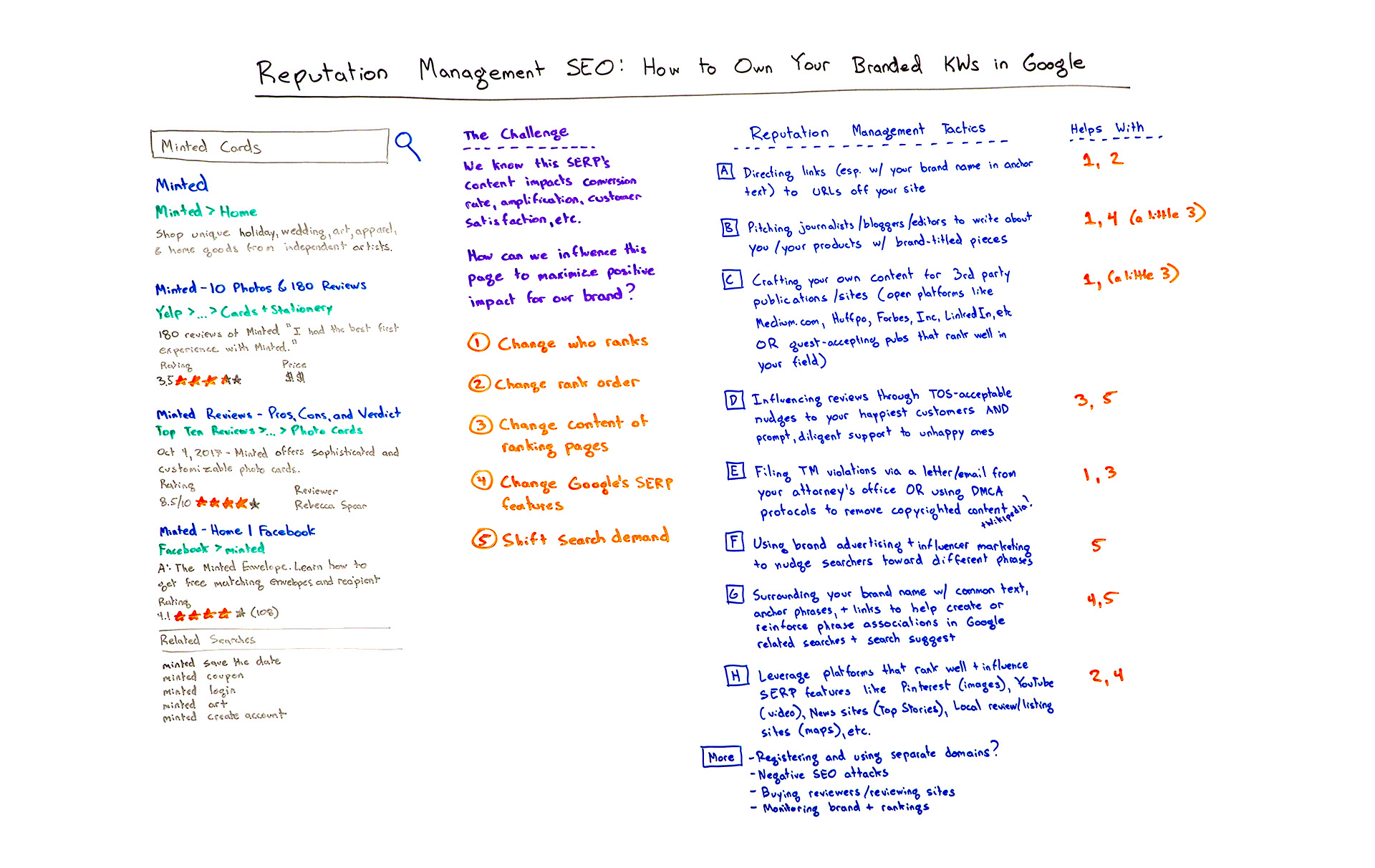
So it turns out I've been having a number of conversations with many of you in the Moz community and many friends of mine in the startup and entrepreneurship worlds about this problem that happens pretty consistently, which is essentially that folks who are searching for your brand in Google experience their first touch before they ever get to your site, their first experience with your brand is through Google's search result page. This SERP, controlling what appears here, what it says, how it says it, who is ranking, where they're ranking, all of those kinds of things, can have a strong input on a bunch of things.

The challenge

We know that the search results' content can impact...
  • Your conversion rate. People see that the reviews are generally poor or the wording is confusing or it creates questions in their mind that your content doesn't answer. That can hurt your conversion rate.
  • It can hurt amplification. People who see you in here, who think that there is something bad or negative about you, might be less likely to link to you or share or talk about you.
  • It can impact customer satisfaction. Customers who are going to buy from you but see something negative in the search results might be more likely to complain about it. Or if they see that you have a lower review or ranking or whatnot, they may be more likely to contribute a negative one than if they had seen that you had stellar ones. Their expectations are being biased by what's in these search results. A lot of times it is totally unfair.

So many of the conversations I've been having, for example with folks in the startup space, are like, "Hey, people are reviewing my product. We barely exist yet. We don't have these people as customers. We feel like maybe we're getting astroturfed by competitors, or someone is just jumping in here and trying to profit off the fact that we have a bunch of brand search now." So pretty frustrating.

How can we influence this page to maximize positive impact for our brand?

There are, however, some ways to address it. In order to change these results, make them better, Minted, for example, of which I should mention I used to be on Minted's Board of Directors, and so I believe my wife and I still have some stock in that company. So full disclosure there. But Minted, they're selling holiday cards. The holiday card market is about to heat up before November and December here in the United States, which is the Christmas holiday season, and that's when they sell a lot of these cards. So we can do a few things.

I. Change who ranks. So potentially remove some and add some new ones in here, give Google some different options. We could change the ranking order. So we could say, "Hey, we prefer this be lower down and this other one be higher up." We can change that through SEO.

II. Change the content of the ranking pages. If you have poor reviews or if someone has written about you in a particular way and you wish to change that, there are ways to influence that as well.

III. Change the SERP features. So we may be able to get images, for example, of Minted's cards up top, which would maybe make people more likely to purchase them, especially if they're exceptionally beautiful.

IV. Add in top stories. If Minted has some great press about them, we could try and nudge Google to use stuff from Google News in here. Maybe we could change what's in related searches, those types of things.

V. Shift search demand. So if it's the case that you're finding that people start typing "Minted" and then maybe are search suggested "Minted versus competitor X" or "Minted card problems" or whatever it is, I don't think either of those are actually in the suggest, but there are plenty of companies who do have that issue. When that's the case, you can also shift the search demand.

Reputation management tactics

Here are a number of tactics that I actually worked on with the help of Moz's Head of SEO, Britney Muller. Britney and I came up with a bunch of tactics, so many that they won't entirely fit on here, but we can describe a few more for you in the comments.

A. Directing link to URLs off your site (Helps with 1 & 2). First off, links are still a big influencer of a lot of the content that you see here. So it is the case that because Yelp is a powerful domain and they have lots of links, potentially even have lots of links to this page about Minted, it's the case that changing up those links, redirecting some of them, adding new links to places, linking out from your own site, linking from articles you contribute to, linking from, for example, the CEO's bio or a prominent influencer on the team's bio when they go and speak at events or contribute to sources, or when Minted makes donations, or when they support public causes, or when they're written about in the press, changing those links and where they point to can have a positive impact.

One of the problems that we see is that a lot of brands think, "All my links about my brand should always go to my homepage." That's not actually the case. It could be the case that you actually want to find, hey, maybe we would like our Facebook page to rank higher. Or hey, we wrote a great piece on Medium about our engineering practices or our diversity practices or how we give back to our community. Let's see if we can point some of our links to that.

B. Pitching journalists or bloggers or editors or content creators on the web (Helps with 1, 4, a little 3), of any kind, to write about you and your products with brand titled pieces. This is on e of the biggest elements that gets missing. For example, a journalist for the San Francisco Chronicle might write a piece about Minted and say something like, "At this startup, it's not unusual to find blah, blah, blah." What you want to do is go, "Come on, man, just put the word 'Minted' in the title of the piece." If they do, you've got a much better shot of having that piece potentially rank in here. So that's something that whoever you're working with on that content creation side, and maybe a reporter at the Chronicle would be much more difficult to do this, but a blogger who's writing about you or a reviewer, someone who's friendly to you, that type of a pitch would be much more likely to have some opportunity in there. It can get into the top stories SERP feature as well.

C. Crafting your own content (Helps with 1, a little 3). If they're not going to do it for you, you can craft your own content. You can do this in two kinds of ways. One is for open platforms like Medium.com or Huffington Post or Forbes or Inc. or LinkedIn, these places that accept those, or guest accepting publications that are much pickier, that are much more rarely taking input, but that rank well in your field. You don't have to think about this exclusively from a link building perspective. In fact, you don't care if the links are nofollow. You don't care if they give you no links at all. What you're trying to do is get your name, your title, your keywords into the title element of the post that's being put up.

D. You can influence reviews (Helps with 3 & 5). Depending on the site, it's different from site to site. So I'm putting TOS acceptable, terms of service acceptable nudges to your happy customers and prompt diligent support to the unhappy ones. So Yelp, for example, says, "Don't solicit directly reviews, but you are allowed to say, 'Our business is featured on Yelp.'" For someone like Minted, Yelp is mostly physical places, and while Minted technically has a location in San Francisco, their offices, it's kind of odd that this is what's ranking here. In fact, I wouldn't expect this to be. I think this is a strange result to have for an online-focused company, to have their physical location in there. So certainly by nudging folks who are using Minted to rather than contribute to their Facebook reviews or their Google reviews to actually say, "Hey, we're also on Yelp. If you've been happy with us, you can check us out there." Not go leave us a review there, but we have a presence.

E. Filing trademark violations (Helps with 1 & 3). So this is a legal path and legal angle, but it works in a couple of different ways. You can do a letter or an email from your attorney's office, and oftentimes that will shut things down. In fact, brief story, a friend of mine, who has a company, found that their product was featured on Amazon's website. They don't sell on Amazon. No one is reselling on Amazon. In fact, the product mostly hasn't even shipped yet. When they looked at the reviews, because they haven't sold very many of their product, it's an expensive product, none of the people who had left reviews were actually their customers. So they went, "What is going on here?" Well, it turns out Amazon, in order to list your product, needs your trademark permission. So they can send an attorney's note to Amazon saying, "Hey, you are using our product, our trademark, our brand name, our visuals, our photos without permission. You need to take that down."

The other way you can go about this is the Digital Millennium Copyright Act (DMCA) protocols. You can do this directly through Google, where you file and say basically, "Hey, they've taken copyrighted content from us and they're using it on their website, and that's illegal." Google will actually remove them from the search results.
This is not necessarily a legal angle, but I bet you didn't know this. A few years ago I had an article on Wikipedia about me, Rand Fishkin. There was like a Wikipedia piece. I don't like that. Wikipedia, it's uncontrollable. Because I'm in the SEO world, I don't have a very good relationship with Wikipedia's editors. So I actually lobbied them, on the talk page of the article about me, to have it removed. There are a number of conditions that Wikipedia has where a page can be removed. I believe I got mine removed under the not notable enough category, which I think probably still applies. That was very successful. So wonderfully, now, Wikipedia doesn't rank for my name anymore, which means I can control the SERPs much more easily. So a potential there too.

F. Using brand advertising and/or influencer marketing to nudge searchers towards different phrases (Helps with 5). So what you call your products, how you market yourself is often how people will search for you. If Minted wanted to change this from Minted cards to minted photo cards, and they really like the results from minted photo cards and those had better conversion rates, they could start branding that through their advertising and their influencer marketing.

G. Surrounding your brand name, a similar way, with common text, anchor phrases, and links to help create or reinforce an association that Google builds around language (Helps with 4 & 5). In that example I said before, having Minted plus a link to their photo cards page or Minted photo cards appearing on the web, not only their own website but everywhere else out there more commonly than Minted cards will bias related searches and search suggest. We've tested this. You can actually use anchor text and surrounding text to sort of bias, in addition to how people search, how Google shows it.

H. Leverage some platforms that rank well and influence SERP features (Helps with 2 & 4). So rather than just trying to get into the normal organic results, we might say, "Hey, I want some images here. Aha, Pinterest is doing phenomenal work at image SEO. If I put up a bunch of pictures from Minted, of Minted's cards or photo cards on Pinterest, I have a much better shot at ranking in and triggering the image results." You can do the same thing with YouTube for videos. You can do the same thing with new sites and for what's called the top stories feature. The same thing with local and local review sites for the maps and local results feature. So all kinds of ways to do that.

More...

Four final topics before we wrap up.

  • Registering and using separate domains? Should I register and use a separate domain, like MintedCardReviews, that's owned by Minted? Generally not. It's not impossible to do reputation management SEO through that, but it can be difficult. I'm not saying you might not want to give it a spin now and then, but generally that's sort of like creating your own reviews, your own site. Google often recognizes those and looks behind the domain registration wall, and potentially you have very little opportunity to rank for those, plus you're doing a ton of link building and that kind of stuff. Better to leverage someone's platform, who can already rank, usually.
  • Negative SEO attacks. You might remember the story from a couple weeks ago, in Fast Company, where Casper, the mattress brand, was basically accused of and found mostly to be generally guilty of going after and buying negative links to a review site that was giving them poor reviews, giving their mattresses poor reviews, and to minimal effect. I think, especially nowadays, this is much less effective than it was a few years ago following Google's last Penguin update. But certainly I would not recommend it. If you get found out for it, you can be sued too.
  • What about buying reviewers and review sites? This is what Casper ended up doing. So that site they were buying negative links against, they ended up just making an offer and buying out the person who owned it. Certainly it is a way to go. I don't know if it's the most ethical or honest thing to do, but it is a possibility.
  • Monitoring brand and rankings. Finally, I would urge you to, if you're not experiencing these today, but you're worried about them, definitely monitor your brand. You could use something like a Fresh Web Explorer or Mention.com or Talkwalker. And your rankings too. You want to be tracking your rankings so that you can see who's popping in there and who's not. Obviously, there are lots of SEO tools to do that.
All right, everyone, thanks for joining us, and we'll see again next week for another edition of Whiteboard Friday. Take care.

Video transcription by Speechpad.com


Sign up for The Moz Top 10, a semimonthly mailer updating you on the top ten hottest pieces of SEO news, tips, and rad links uncovered by the Moz team. Think of it as your exclusive digest of stuff you don't have time to hunt down but want to read!

Tuesday, July 17, 2018

The Local SEO’s Guide to the Buy Local Phenomenon: A Competitive Advantage for Clients

Posted by MiriamEllis

Photo credit: Michelle Shirley

What if a single conversation with one of your small local business clients could spark activity that would lead to an increase in their YOY sales of more than 7%, as opposed to only 4% if you don’t have the conversation? What if this chat could triple the amount of spending that stays in their town, reduce pollution in their community, improve their neighbors’ health, and strengthen democracy?

What if the brass ring of content dev, link opportunities, consumer sentiment and realtime local inventory is just waiting for you to grab it, on a ride we just haven’t taken yet, in a setting we’re just not talking about?

Let’s travel a different road today, one that parallels our industry’s typical conversation about citations, reviews, markup, and Google My Business. As a 15-year sailor on the Local SEO ship, I love all this stuff, but, like you, I’m experiencing a merging of online goals with offline realities, a heightened awareness of how in-store is where local business successes are born and bred, before they become mirrored on the web.

At Moz, our SaaS tools serve businesses of every kind: Digital, bricks-and-mortar, SABs, enterprises, mid-market agencies, big brands, and bootstrappers. But today, I’m going to go as small and as local as possible, speaking directly to independently-owned local businesses and their marketers about the buy local/shop local/go local movement and what I’ve learned about its potential to deliver meaningful and far-reaching successes. Frankly, I think you’ll be as amazed as I’ve been.

At the very least, I hope reading this article will inspire you to have a conversation with your local business clients about what this growing phenomenon could do for them and for their communities. Successful clients, after all, are the very best kind to have.

What is the Buy Local movement all about?

What’s the big idea?

You’re familiar with the concept of there being power in numbers. A single independent business lacks the resources and clout to determine the local decisions and policies that affect it. Should Walmart or Target be invited to set up shop in town? Should the crumbling building on Main St. be renovated or demolished? Which safety and cultural services should be supported with funding? The family running the small grocery store has little say, but if they join together with the folks running the bakery, the community credit union, the animal shelter, and the bookstore ... then they begin to have a stronger voice.

Who does this?

Buy Local programs formalize the process of independently-owned businesses joining together to educate their communities about the considerable benefits to nearly everyone of living in a thriving local economy. These efforts can be initiated by merchants, Chambers of Commerce, grassroots citizen groups, or others. They can be assisted and supported by non-profit organizations like the American Independent Business Alliance (AMIBA) and the Institute for Local Self-Reliance (ILSR).

What are the goals?

Through signage, educational events, media promotions, and other forms of marketing, most Buy Local campaigns share some or all of these goals:

  • Increase local wealth that recirculates within the community
  • Preserve local character
  • Build community
  • Create good jobs
  • Have a say in policy-making
  • Decrease environmental impacts
  • Support entrepreneurship
  • Improve diversity/variety
  • Compete with big businesses

Do Buy Local campaigns actually work?

Yes - research indicates that, if managed correctly, these programs yield a variety of benefits to both merchants and residents. Consider these findings:

1) Healthy YOY sales advantages

ILSR conducted a national survey of independent businesses to gauge YOY sales patterns. 2016 respondents reported a good increase in sales across the board, but with a significant difference which AMIBA sums up:

“Businesses in communities with a sustained grassroots “buy independent/buy local” campaign reported a strong 7.4% sales increase, nearly doubling the 4.2% gain for those in areas without such an alliance.”

2) Keeping spending local

The analysts at Civic Economics conducted surveys of 10 cities to gauge the local financial impacts of independents vs. chain retailers, yielding a series of graphics like this one:

While statistics vary from community to community, the overall pattern is one of significantly greater local recirculation of wealth in the independent vs. chain environment. These patterns can be put to good use by Buy Local campaigns with the goal of increasing community-sustaining wealth.

3) Keeping communities employed and safe

Few communities can safely afford the loss of jobs and tax revenue documented in a second Civic Economics study which details the impacts of Americans’ Amazon habit, state by state and across the nation:

While the recent supreme court ruling allowing states to tax e-commerce models could improve some of these dire numbers, towns and cities with Buy Local alliances can speak plainly: Lack of tax revenue that leads to lack of funding for emergency services like fire departments is simply unsafe and unsustainable. A study done a few years back found that ⅔ of volunteer firefighters in the US report that their departments are underfunded with 86% of these heroic workers having to dip into their own pockets to buy supplies to keep their stations going. As I jot these statistics down, there is a runaway 10,000 acre wildfire burning a couple of hours north of me…

Meanwhile, Inc.com is pointing out,

“According to the Bureau of Labor Statistics, since the end of the Great Recession, small businesses have created 62 percent of all net new private-sector jobs. Among those jobs, 66 percent were created by existing businesses, while 34 percent were generated through new establishments (adjusted for establishment closings and job losses)”.

When communities have Go Local-style business alliances, they are capitalizing on the ability to create jobs, increase sales, and build up tax revenue that could make a serious difference not just to local unemployment rates, but to local safety.

4) Shaping policy

In terms of empowering communities to shape policy, there are many anecdotes to choose from, but one of the most celebrated surrounds a landmark study conducted by the Austin Independent Business Alliance which documented community impacts of spending at the local book and music stores vs. a proposed Borders. Their findings were compelling enough to convince the city not to give a $2.1 million subsidy to the now-defunct corporation.

5) Improving the local environment

A single statistic here is incredibly eye opening. According to the US Department of Transportation, shopping-related driving per household more than tripled between 1969-2009.

All you have to do is picture to yourself the centralized location of mainstreet businesses vs. big boxes on the outskirts of town to imagine how city planning has contributed to this stunning rise in time spent on the road. When residents can walk or bike to make daily purchases, the positive environmental impacts are obvious.

6) Improving residents’ health and well-being

A recent Cigna survey of 20,000 Americans found that nearly half of them always or sometimes feel lonely, lacking in significant face-to-face interactions with others. Why does this matter? Because the American Psychological Association finds that you have a 50% less chance of dying prematurely if you have quality social interactions.

There’s a reason author Jan Karon’s “Mitford” series about life in a small town in North Carolina has been a string of NY Times Best Sellers; readers and reviewers continuously state that they yearn to live someplace like this fictitious community with the slogan “Mitford takes care of its own”. In the novels, the lives of residents, independent merchants, and “outsiders” interweave, in good times and bad, creating a support network many Americans envy.

This societal setup must be a winner, as well as a bestseller, because the Cambridge Journal of Regions published a paper in which they propose that the concentration of small businesses in a given community can be equated with levels of public health.

Beyond the theory that eating fresh and local is good for you, it turns out that knowing your farmer, your banker, your grocer could help you live longer.

7) Realizing big-picture goals

Speaking of memorable stories, this video from ILSR does a good job of detailing one view of the ultimate impacts independent business alliances can have on shaping community futures:

https://www.youtube.com/watch?time_continue=150&=&v=kDw4dZLSDXg

I interviewed author and AMIBA co-founder, Jeff Milchen, about the good things that can happen when independents join hands. He summed it up,

“The results really speak for themselves when you look at what the impact of public education for local alliances has been in terms of shifting culture. It’s a great investment for independent businesses to partner with other independents, to do things they can’t do individually. Forming these partnerships can help them compete with the online giants.”

Getting going with a Go Local campaign, the right way

If sharing some of the above with clients has made them receptive to further exploration of what involvement in an independent business alliance might do for them, here are the next steps to take:

  1. First, find out if a Go Local/Shop Local/Buy Local/Stay Local campaign already exists in the business’ community. If so, the client can join up.
  2. If not, contact AMIBA. The good folks there will know if other local business owners in the client’s community have already expressed interest in creating an alliance. They can help connect the interested parties up.
  3. I highly, highly recommend reading through Amiba’s nice, free primer covering just about everything you need to know about Go Local campaigns.
  4. Encourage the client to publicize their intent to create an alliance if none exists in their community. Do an op ed in the local print news, put it on social media sites, talk to neighbors. This can prompt outreach from potential allies in the effort.
  5. A given group can determine to go it alone, but it may be better to rely on the past experience of others who have already created successful campaigns. AMIBA offers a variety of paid community training modules, including expert speakers, workshops, and on-site consultations. Each community can write in to request a quote for a training plan that will work best for them. The organization also offers a wealth of free educational materials on their website.
  6. According to AMIBA’s Jeff Milchen, a typical Buy Local campaign takes about 3-4 months to get going.

It’s important to know that Go Local campaigns can fail, due to poor execution. Here is a roundup of practices all alliances should focus on to avoid the most common pitfalls:

  1. Codify the definition of a “local” business as being independently-owned-and-run, or else big chain inclusion will anger some members and cause them to leave.
  2. Emphasize all forms of local patronage; campaigns that stick too closely to words like “buy” or “shop” overlook the small banks, service area businesses, and other models that are an integral part of the independent local economy.
  3. Ensure diversity in leadership; an alliance that fails to reflect the resources of age, race, gender/identity, political views, economics and other factors may wind up perishing from narrow viewpoints. On a related note, AMIBA has been particularly active in advocating for business communities to rid themselves of bigotry. Strong communities welcome everyone.
  4. Do the math of what success looks like; education is a major contributing factor to forging a strong alliance, based on projected numbers of what campaigns can yield in concrete benefits for both merchants and residents.
  5. Differentiate inventory and offerings so that independently-owned businesses offer something of added value which patrons can’t easily replicate online; this could be specialty local products, face-to-face time with expert staff, or other benefits.
  6. Take the high road in inspiring the community to increase local spending; campaigns should not rely on vilifying big and online businesses or asking for patronage out of pity. In other words, guilt-tripping locals because they do some of their shopping at Walmart or Amazon isn’t a good strategy. Even a 10% shift towards local spending can have positive impacts for a community!
  7. Clearly assess community resources; not every town, city, or district hosts the necessary mix of independent businesses to create a strong campaign. For example, approximately 2.2% of the US population live in “food deserts”, many miles from a grocery store. These areas may lack other local businesses, as well, and their communities may need to create grassroots campaigns surrounding neighborhood gardens, mobile markets, private investors and other creative solutions.

In sum, success significantly depends on having clear definitions, clear goals, diverse participants and a proud identity as independents, devoid of shaming tactics.

Circling back to the Web — our native heath!

So, let’s say that your incoming client is now participating in a Buy Local program. Awesome! Now, where do we go from here?

In speaking with Jeff Milchen, I asked what he has seen in terms of digital marketing being used to promote the businesses involved in Buy Local campaigns. He said that, while some alliances have workshops, it’s a work in progress and something he hopes to see grow in the future.

As a Local SEO, that future is now for you and your fortunate clients. Here are some ways I see this working out beautifully:

Basic data distribution and consistency

Small local businesses can sometimes be unaware of inconsistent or absent local business listings, because the owners are just so busy. The quickest way I know to demo this scenario is to plug the company name and zip into the free Moz Check Listing tool to show them how they’re doing on the majors. Correct data errors and fill in the blanks, either manually, or, using affordable software like Moz Local. You’ll also want to be sure the client has a presence on any geo or industry-specific directories and platforms. It’s something your agency can really help with!

A hyperlocalized content powerhouse

Build proud content around the company’s involvement in the Buy Local program.

  • Write about all of the economic, environmental, and societal benefits residents can support by patronizing the business.
  • Motivated independents take time to know their customers. There are stories in this. Write about the customers and their needs. I’ve even seen independent restaurants naming menu items after beloved patrons. Get personal. Build community.
  • Don’t forget that even small towns can be powerful points of interest for tourists. Create a warm welcome for travelers, and for new neighbors, too!

Link building opportunities of a lifetime

Local business alliances form strong B2B bonds.

  • Find relationships with related businesses that can sprout links. For example, the caterer knows the wedding cake baker, who knows the professional seamstress, who knows the minister, who knows the DJ, who knows the florist.
  • Dive deep into opportunities for sponsoring local organizations, teams and events, hosting and participating in workshops and conferences, offering scholarships and special deals.
  • Make fast friends with local media. Be newsworthy.

A wellspring of sentiment

Independents form strong business-to-community bonds.

  • When a business really knows its customers, asking for online reviews is so much easier. In some communities, it may be necessary to teach customers how to leave reviews, but once you get a strategy going for this, the rest is gravy.
  • It’s also a natural fit for asking for written and video testimonials to be published on the company website.
  • Don’t forget the power of Word of Mouth Marketing, while you’re at it. Loyal patrons are an incredible asset.
  • The one drawback could be if your business model is one of a sensitive nature. Tight-knit communities can be ones in residents may be more desirous of protecting their privacy.

Digitize inventory easily

30% of consumers say they’d buy from a local store instead of online if they knew the store was nearby (Google). Over half of consumers prefer to shop in-store to interact with products (Local Search Association). Over 63% of consumers would rather buy from a company they consider to be authentic over the competition (Bright Local).

It all adds up to the need for highly-authentic independently-owned businesses to have an online presence that signals to Internet users that they stock desired products. For many small, local brands, going full e-commerce on their website is simply too big of an implementation and management task. It’s a problem that’s dogged this particular business sector for years. And it’s why I got excited when the folks at AMIBA told me to check out Pointy.

Pointy offers a physical device that small business owners can attach to their barcode scanner to have their products ported to a Pointy-controlled webpage. But, that’s not all. Pointy integrates with the “See What’s In Store” inventory function of Google My Business Knowledge Panels. Check out Talbot’s Toyland in San Mateo, CA for a live example.

Pointy is a startup, but one that is exciting enough to have received angel investing from the founder of Wordpress and the co-founder of Google Maps. Looks like a real winner to me, and it could provide a genuine answer for brick-and-mortar independents who have found their sales staggering in the wake of Amazon and other big digital brands.

Local SEOs have an important part to play

Satisfaction in work is a thing to be cherished. If the independent business movement speaks to you, bringing your local search marketing skills to these alliances and small brands could make more of your work days really good days.

The scenario could be an especially good fit for agencies that have specialized in city or state marketing. For example, one of our Moz Community members confines his projects to South Carolina. Imagine him taking it on the road a bit, hosting and attending workshops for towns across the state that are ready to revitalize main street. An energetic client roster could certainly result if someone like him could show local banks, grocery stores, retail shops and restaurants how to use the power of the local web!

Reading America

Our industry is living and working in complex times.

The bad news is, a current Bush-Biden poll finds that 8/10 US residents are “somewhat” or “very” concerned about the state of democracy in our nation.

The not-so-bad news is that citizen ingenuity for discovering solutions and opportunities is still going strong. We need only look as far as the runaway success of the TV show “Fixer Upper”, which drew 5.21 million viewers in its fourth season as the second-largest telecast of Q2 of that year. The show surrounded the revitalization of dilapidated homes and businesses in and around Waco, Texas, and has turned the entire town into a major tourist destination, pulling in millions of annual visitors and landing book deals, a magazine, and the Magnolia Home furnishing line for its entrepreneurial hosts.

While not every town can (or would want to) experience what is being called the “Magnolia effect”, channels like HGTV and the DIY network are heavily capitalizing on the rebirth of American communities, and private citizens are taking matters into their own hands.

There’s the family who moved from Washington D.C. to Water Valley, Mississippi, bought part of the decaying main street and began to refurbish it. I found the video story of this completely riveting, and look at the Yelp reviews of the amazing grocery store and lunch counter these folks are operating now. The market carries local products, including hoop cheese and milk from the first dairy anyone had opened in 50 years in the state.

There are the half-dozen millennials who are helping turn New Providence, Iowa into a place young families can live and work again. There’s Corning, NY, Greensburg, KS, Colorado Springs, CO, and so many more places where people are eagerly looking to strengthen community sufficiency and sustainability.

Some marketing firms are visionary forerunners in this phenomenon, like Deluxe, which has sponsored the Small Business Revolution show, doing mainstreet makeovers that are bringing towns back to life. There could be a place out there somewhere on the map of the country, just waiting for your agency to fill it.

The best news is that change is possible. A recent study in Science magazine states that the tipping point for a minority group to change a majority viewpoint is 25% of the population. This is welcome news at a time when 80% of citizens are feeling doubtful about the state of our democracy. There are 28 million small businesses in the United States - an astonishing potential educational force - if communities can be taught what a vote with their dollar can do in terms of giving them a voice. As Jeff Milchen told me:

One of the most inspiring things is when we see local organizations helping residents to be more engaged in the future of their community. Most communities feel somewhat powerless. When you see towns realize they have the ability to shift public policy to support their own community, that’s empowering.”

Sometimes, the extremes of our industry can make our society and our democracy hard to read. On the one hand, the largest brands developing AI, checkout-less shopping, driverless cars, same-day delivery via robotics, and the gig economy win applause at conferences.

On the other hand, the public is increasingly hearing the stories of employees at these same companies who are protesting Microsoft developing face recognition for ICE, Google’s development of AI drone footage analysis for the Pentagon, working conditions at Amazon warehouses that allegedly preclude bathroom breaks and have put people in the hospital, and the various outcomes of the “Walmart Effect”.

The Buy Local movement is poised in time at this interesting moment, in which our democracy gets to choose. Gigs or unions? Know your robot or know your farmer? Convenience or compassion? Is it either/or? Can it be both?

Both big and small brands have a major role to play in answering these timely questions and shaping the ethics of our economy. Big brands, after all, have tremendous resources for raising the bar for ethical business practices. Your agency likely wants to serve both types of clients, but it’s all to the good if all business sectors remember that the real choosers are the “consumers”, the everyday folks voting with their dollars.

I know that it can be hard to find good news sometimes. But I’m hoping what you’ve read today gifts you with a feeling of optimism that you can take to the office, take to your independently-owned local business clients, and maybe even help take to their communities. Spark a conversation today and you may stumble upon a meaningful competitive advantage for your agency and its most local customers.

Every year, local SEOs are delving deeper and deeper into the offline realities of the brands they serve, large and small. We’re learning so much, together. It’s sometimes a heartbreaker, but always an honor, being part of this local journey.


Sign up for The Moz Top 10, a semimonthly mailer updating you on the top ten hottest pieces of SEO news, tips, and rad links uncovered by the Moz team. Think of it as your exclusive digest of stuff you don't have time to hunt down but want to read!

Friday, July 13, 2018

The Rules of Link Building - Whiteboard Friday

Posted by BritneyMuller

Are you building links the right way? Or are you still subscribing to outdated practices? Britney Muller clarifies which link building tactics still matter and which are a waste of time (or downright harmful) in today's episode of Whiteboard Friday.

The Rules of Link Building

Click on the whiteboard image above to open a high-resolution version in a new tab!

Video Transcription

Happy Friday, Moz fans! Welcome to another edition of Whiteboard Friday. Today we are going over the rules of link building. It's no secret that links are one of the top three ranking factors in Goggle and can greatly benefit your website. But there is a little confusion around what's okay to do as far as links and what's not. So hopefully, this helps clear some of that up.

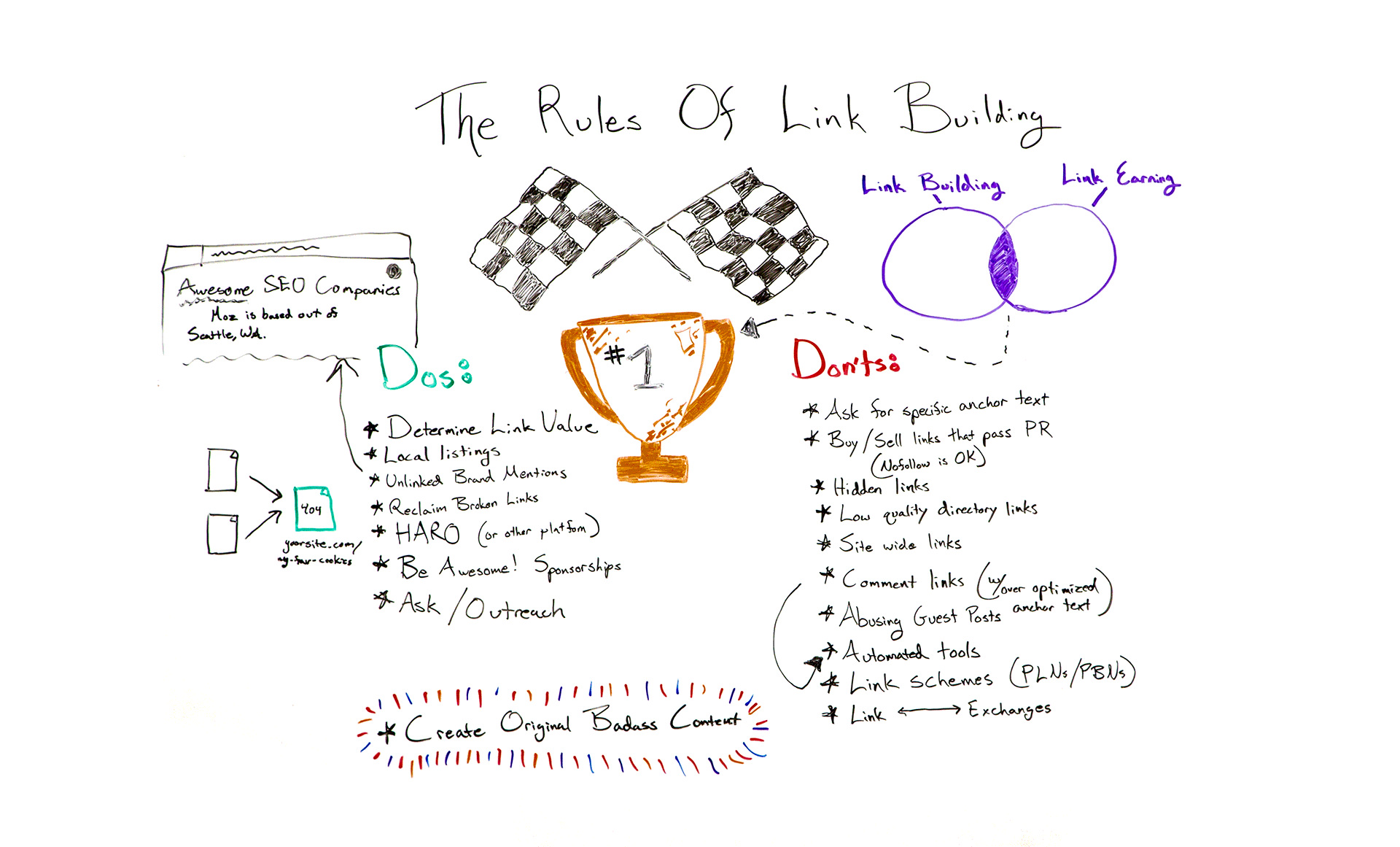
The Dos

All right. So what are the dos? What do you want to be doing? First and most importantly is just to...

I. Determine the value of that link. So aside from ranking potential, what kind of value will that link bring to your site? Is it potential traffic? Is it relevancy? Is it authority? Just start to weigh out your options and determine what's really of value for your site.

II. Local listings still do very well. These local business citations are on a bunch of different platforms, and services like Moz Local or Yext can get you up and running a little bit quicker. They tend to show Google that this business is indeed located where it says it is. It has consistent business information — the name, address, phone number, you name it. But something that isn't really talked about all that often is that some of these local listings never get indexed by Google. If you think about it, Yellowpages.com is probably populating thousands of new listings a day. Why would Google want to index all of those?

So if you're doing business listings, an age-old thing that local SEOs have been doing for a while is create a page on your site that says where you can find us online. Link to those local listings to help Google get that indexed, and it sort of has this boomerang-like effect on your site. So hope that helps. If that's confusing, I can clarify down below. Just wanted to include it because I think it's important.

III. Unlinked brand mentions. One of the easiest ways you can get a link is by figuring out who is mentioning your brand or your company and not linking to it. Let's say this article publishes about how awesome SEO companies are and they mention Moz, and they don't link to us. That's an easy way to reach out and say, "Hey, would you mind adding a link? It would be really helpful."

IV. Reclaiming broken links is also a really great way to kind of get back some of your links in a short amount of time and little to no effort. What does this mean? This means that you had a link from a site that now your page currently 404s. So they were sending people to your site for a specific page that you've since deleted or updated somewhere else. Whatever that might be, you want to make sure that you 301 this broken link on your site so that it pushes the authority elsewhere. Definitely a great thing to do anyway.

V. HARO (Help a Reporter Out). Reporters will notify you of any questions or information they're seeking for an article via this email service. So not only is it just good general PR, but it's a great opportunity for you to get a link. I like to think of link building as really good PR anyway. It's like digital PR. So this just takes it to the next level.

VI. Just be awesome. Be cool. Sponsor awesome things. I guarantee any one of you watching likely has incredible local charities or amazing nonprofits in your space that could use the sponsorship, however big or small that might be. But that also gives you an opportunity to get a link. So something to definitely consider.

VII. Ask/Outreach. There's nothing wrong with asking. There's nothing wrong with outreach, especially when done well. I know that link building outreach in general kind of gets a bad rap because the response rate is so painfully low. I think, on average, it's around 4% to 7%, which is painful. But you can get that higher if you're a little bit more strategic about it or if you outreach to people you already currently know. There's a ton of resources available to help you do this better, so definitely check those out. We can link to some of those below.

VIII. COBC (create original badass content). We hear lots of people talk about this. When it comes to link building, it's like, "Link building is dead. Just create great content and people will naturally link to you. It's brilliant." It is brilliant, but I also think that there is something to be said about having a healthy mix. There's this idea of link building and then link earning. But there's a really perfect sweet spot in the middle where you really do get the most bang for your buck.

The Don'ts

All right. So what not to do. The don'ts of today's link building world are...

I. Don't ask for specific anchor text. All of these things appear so spammy. The late Eric Ward talked about this and was a big advocate for never asking for anchor text. He said websites should be linked to however they see fit. That's going to look more natural. Google is going to consider it to be more organic, and it will help your site in the long run. So that's more of a suggestion. These other ones are definitely big no-no's.

II. Don't buy or sell links that pass PageRank. You can buy or sell links that have a no-follow attached, which attributes that this is paid-for, whether it be an advertisement or you don't trust it. So definitely looking into those and understanding how that works.

III. Hidden links. We used to do this back in the day, the ridiculous white link on a white background. They were totally hidden, but crawlers would pick them up. Don't do that. That's so old and will not work anymore. Google is getting so much smarter at understanding these things.

IV. Low-quality directory links. Same with low-quality directory links. We remember those where it was just loads and loads of links and text and a random auto insurance link in there. You want to steer clear of those.

V. Site-wide links also look very spammy. Site wide being whether it's a footer link or a top-level navigation link, you definitely don't want to go after those. They can appear really, really spammy. Avoid those.

VI. Comment links with over-optimized anchor link text, specifically, you want to avoid. Again, it's just like any of these others. It looks spammy. It's not going to help you long term. Again, what's the value of that overall? So avoid that.

VII. Abusing guest posts. You definitely don't want to do this. You don't want to guest post purely just for a link. However, I am still a huge advocate, as I know many others out there are, of guest posting and providing value. Whether there be a link or not, I think there is still a ton of value in guest posting. So don't get rid of that altogether, but definitely don't target it for potential link building opportunities.

VIII. Automated tools used to create links on all sorts of websites. ScrapeBox is an infamous one that would create the comment links on all sorts of blogs. You don't want to do that.

IX. Link schemes, private link networks, and private blog networks. This is where you really get into trouble as well. Google will penalize or de-index you altogether. It looks so, so spammy, and you want to avoid this.

X. Link exchange. This is in the same vein as the link exchanges, where back in the day you used to submit a website to a link exchange and they wouldn't grant you that link until you also linked to them. Super silly. This stuff does not work anymore, but there are tons of opportunities and quick wins for you to gain links naturally and more authoritatively.

So hopefully, this helps clear up some of the confusion. One question I would love to ask all of you is: To disavow or to not disavow? I have heard back-and-forth conversations on either side on this. Does the disavow file still work? Does it not? What are your thoughts? Please let me know down below in the comments.

Thank you so much for tuning in to this edition of Whiteboard Friday. I will see you all soon. Thanks.

Video transcription by Speechpad.com


Sign up for The Moz Top 10, a semimonthly mailer updating you on the top ten hottest pieces of SEO news, tips, and rad links uncovered by the Moz team. Think of it as your exclusive digest of stuff you don't have time to hunt down but want to read!

Tuesday, July 10, 2018

Your Red-Tape Toolkit: 7 Ways to Earn Trust and Get Your Search Work Implemented

Posted by HeatherPhysioc

Tell me if this rings a bell. Are your search recommendations overlooked and misunderstood? Do you feel like you hit roadblocks at every turn? Are you worried that people don't understand the value of your work?

I had an eye-opening moment when my colleague David Mitchell, Chief Technology Officer at VML, said to me, “You know the best creatives here aren’t the ones who are the best artists — they’re the ones who are best at talking about the work.”

I have found that the same holds true in search. As an industry, we are great at talking about the work — we’re fabulous about sharing technical knowledge and new developments in search. But we’re not so great at talking about how we talk about the work. And that can make all the difference between our work getting implementing and achieving great results, or languishing in a backlog.

It’s so important to learn how to navigate corporate bureaucracy and cut through red tape to help your clients and colleagues understand your search work — and actually get it implemented. From diagnosing client maturity to communicating where search fits into the big picture, the tools I share in this article can help equip you to overcome obstacles to doing your best work.

Buying Your Services ≠ Buying In

Just because a client signed a contract with you does not mean they are bought-in to implement every change you recommend. It seemingly defies all logic that someone would agree that they need organic search help enough to sign a contract and pay you to make recommendations, only for the recommendations to never go live.

When I was an independent contractor serving small businesses, they were often overwhelmed by their marketing and willing to hand over the keys to the website so my developers could implement SEO recommendations.

Then, as I got into agency life and worked on larger and larger businesses, I quickly realized it was a lot harder to get SEO work implemented. I started hitting roadblocks with a number of clients, and it was a slow, arduous process to get even small projects pushed through. It was easy to get impatient and fed up.

Worse, it was hard for some of my team members to see their colleagues getting great search work implemented and earning awesome results for their clients, while their own clients couldn’t seem to get anything implemented. It left them frustrated, jaded, feeling inadequate, and burned out — all the while the client was asking where the results were for the projects they didn’t implement.

What Stands in the Way of Getting Your Work Implemented

I surveyed colleagues in our industry about the common challenges they experience when trying to get their recommendations implemented. (Thank you to the 141 people who submitted!) The results were roughly one-third in-house marketers and two-thirds external marketers providing services to clients.

The most common obstacles we asked about fell into a few main categories:

  • Low Understanding of Search
    • Client Understanding
    • Peer/Colleague Understanding
    • Boss Understanding
  • Prioritization & Buy-In
    • Low Prioritization of Search Work
    • External Buy-In from Clients
    • Internal Buy-In from Peers
    • Internal Buy-In from Bosses
    • Past Unsuccessful Projects or Mistakes
  • Corporate Bureaucracy
    • Red Tape and Slow Approvals
    • No Advocate or Champion for Search
    • Turnover or Personnel Changes (Client-Side)
    • Difficult or Hostile Client
  • Resource Limitations
    • Technical Resources for Developers / Full Backlog
    • Budget / Scope Too Low to Make Impact
    • Technical Limitations of Digital Platform

The chart below shows how the obstacles in the survey stacked up. Higher scores mean people reported it as a more frequent or common problem they experience:

Some participants also wrote in additional blocks they’ve encountered - everything from bottlenecks in the workflow to over-complicated processes, lack of ownership to internal politics, shifting budgets to shifting priorities.

Too real? Are you completely bummed out yet? There is clearly no shortage of things that can stand in the way of SEO progress, and likely our work as marketers will never be without challenges.

Playing the Blame Game

When things don’t go our way and our work gets intercepted or lost before it ever goes live, we tend to be quick to blame clients. It’s the client’s fault things are hung up, or if the client had only listened to us, and the client’s business is the problem.

But I don’t buy it.

Don’t get me wrong — this could possibly be true in part in some cases, but rarely is it the whole story and rarely are we completely hopeless to affect change. Sometimes the problem is the system, sometimes the problem is the people, and my friends, sometimes the problem is you.

But fortunately, we are all optimizers — we all inherently believe that things could be just a little bit better.

These are the tools you need in your belt to face many of the common obstacles to implementing your best search work.

7 Techniques to Get Your Search Work Approved & Implemented

When we enter the world of search, we are instantly trained on how to execute the work – not the soft skills needed to sustain and grow the work, break down barriers, get buy-in and get stuff implemented. These soft skills are critical to maximize your search success for clients, and can lead to more fruitful, long-lasting relationships.

Below are seven of the most highly recommended skills and techniques, from the SEO professionals surveyed and my own experience, to learn in order to increase the likelihood your work will get implemented by your clients.

1. How Mature Is Your Client?

Challenges to implementation tend to be organizational, people, integration, and process problems. Conducting a search maturity assessment with your client can be eye-opening to what needs to be solved internally before great search work can be implemented. Pairing a search capabilities model with an organizational maturity model gives you a wealth of knowledge and tools to help your client.

I recently wrote an in-depth article for the Moz blog about how to diagnose your client’s search maturity in both technical SEO capabilities and their organizational maturity as it pertains to a search program.

For search, we can think about a maturity model two ways. One may be the actual technical implementation of search best practices — is the client implementing exceptional, advanced SEO, just the basics, nothing at all, or even operating counterproductively? This helps identify what kinds of project make sense to start with for your client. Here is a sample maturity model across several aspects of search that you can use or modify for your purposes:

This SEO capabilities maturity model only starts to solve for what you should implement, but doesn’t get to the heart of why it’s so hard to get your work implemented. The real problems are a lot more nuanced, and aren’t as easy as checking the boxes of “best practices SEO.”

We also need to diagnose the organizational maturity of the client as it pertains to building, using and evolving an organic search practice. We have to understand the assets and obstacles of our client’s organization that either aid or block the implementation of our recommendations in order to move the ball forward.

If, after conducting these maturity model exercises, we find that a client has extremely limited personnel, budget and capacity to complete the work, that’s the first problem we should focus on solving for — helping them allocate proper resources and prioritization to the work.

If we find that they have plenty of personnel, budget, and capacity, but have no discernible, repeatable process for integrating search into their marketing mix, we focus our efforts there. How can we help them define, implement, and continually evolve processes that work for them and with the agency?

Perhaps the maturity assessment finds that they are adequate in most categories, but struggle with being reactive and implementing retrofitted SEO only as an afterthought, we may help them investigate their actionable workflows and connect dots across departments. How can we insert organic search expertise in the right ways at the right moments to have the greatest impact?

2. Speak to CEOs and CMOs, Not SEOs

Because we are subject matter experts in search, we are responsible for educating clients and colleagues on the power of SEO and the impact it can have on brands. If the executives are skeptical or don’t care about search, it won’t happen. If you want to educate and inspire people, you can’t waste time losing them in the details.

Speak Their Language

Tailor your educational content to busy CEOs and CMOs, not SEOs. Make the effort to listen to, read, write, and speak their corporate language. Their jargon is return on investment, earnings per share, operational costs. Yours is canonicalization, HTTPS and SSL encryption, 302 redirects, and 301 redirect chains.

Be mindful that you are coming from different places and meet them in the middle. Use layperson’s terms that anyone can understand, not technical jargon, when explaining search.

Don’t be afraid to use analogies (i.e. instead of “implement permanent 301 redirect rewrite rules in the .htaccess file to correct 404 not found errors,” perhaps “it’s like forwarding your mail when you change addresses.”)

Get Out of the Weeds

Perhaps because we are so passionate about the inner workings of search, we often get deep into the weeds of explaining how every SEO signal works. Even things that seem not-so-technical to us (title tags and meta description tags, for example) can lose your audience’s attention in a heartbeat. Unless you know that the client is a technical mind who loves to get in the weeds or that they have search experience, stay at 30,000 feet.

Another powerful tool here is to show, not tell. Often you can tell a much more effective and hard-hitting story using images or smart data visualization. Your audience being able to see instead of trying to listen and decipher what you’re proposing can allow you to communicate complex information much more succinctly.

Focus on Outcomes

The goal of educating is not teaching peers and clients how to do search. They pay you to know that. Focus on the things that actually matter to your audience. (Come on, we’re inbound marketers — we should know this!) For many brands, that may include benefits like how it will build their brand visibility, how they can conquest competitors, and how they can make more money. Focus on the outcomes and benefits, not the granular, technical steps of how to get there.

What’s In It for Them?

Similarly, if you are doing a roadshow to educate your peers in other disciplines and get their buy-in, don’t focus on teaching them everything you know. Focus on how your work can benefit them (make their work smarter, more visible, make them more money) rather than demanding what other departments need to do for you. Aim to align on when, where, and how your two teams intersect to get greater results together.

3. SEO is Not the Center of the Universe

It was a tough pill for me to swallow when I realized that my clients simply didn’t care as much about organic search as my team and I did. (I mean, honestly, who isn’t passionate about dedicating their careers to understanding human thinking and behavior when we search, then optimizing technical stuff and website content for those humans to find it?!)

Bigger Fish to Fry

While clients may honestly love the sound of things we can do for them with search, rarely is SEO the only thing — or even a sizable thing — on a client’s mind. Rarely is our primary client contact someone who is exclusively dedicated to search, and typically, not even exclusively to digital marketing. We frequently report to digital directors and CMOs who have many more and much bigger fish to fry.

They have to look at the big picture and understand how the entire marketing mix works, and in reality, SEO is only one small part of that. While organic search is typically a client’s biggest source of traffic to their website, we often forget that the website isn’t even at the top of the priorities list for many clients. Our clients are thinking about the whole brand and the entirety of its marketing performance, or the organizational challenges they need to overcome to grow their business. SEO is just one small piece of that.

Acknowledge the Opportunity Cost

The benefits of search are no-brainers for us and it seems so obvious, but we fail to acknowledge that every decision a CMO makes has a risk, time commitment, risks and costs associated with it. Every time they invest in something for search, it is an opportunity cost for another marketing initiative. We fail to take the time to understand all the competing priorities and things that a client has to choose between with a limited budget.

To persuade them to choose an organic search project over something else — like a paid search, creative, paid media, email, or other play — we had better make a damn good case to justify not just the hard cost in dollars, but the opportunity cost to other marketing initiatives. (More on that later.)

Integrated Marketing Efforts

More and more, brands are moving to integrated agency models in hopes of getting more bang for their buck by maximizing the impact of every single campaign across channels working together, side-by-side. Until we start to think more about how SEO ladders up to the big picture and works alongside or supports larger marketing initiatives and brand goals, we will continue to hamstring ourselves when we propose ideas to clients.

It’s our responsibility to seek big-picture perspective and figure out where we fit. We have to understand the realities of a client’s internal and external processes, their larger marketing mix and SEO’s role in that. SEO experts tend to obsess over rankings and website traffic. But we should be making organic search recommendations within the context of their goals and priorities — not what we think their goals and priorities should be.

For example, we have worked on a large CPG food brand for several years. In year one, my colleagues did great discovery works and put together an awesome SEO playbook, and we spent most of the year trying to get integrated and trying to check all these SEO best practices boxes for the client. But no one cared and nothing was getting implemented. It turned out that our “SEO best practices” didn’t seem relevant to the bigger picture initiatives and brand campaigns they had planned for the year, so they were being deprioritized or ignored entirely. In year two, our contract was restructured to focus search efforts primarily on the planned campaigns for the year. Were we doing the search work we thought we would be doing for the client? No. Are we being included more and getting great search work implemented finally? Yes. Because we stopped trying to veer off in our own direction and started pulling the weight alongside everyone else toward a common vision.

4. Don’t Stay in Your Lane, Get Buy-In Across Lanes

Few brands hire only SEO experts and no other marketing services to drive their business. They have to coordinate a lot of moving pieces to drive all of them forward in the same direction as best they can. In order to do that, everyone has to be aligned on where we’re headed and the problems we’re solving for.

Ultimately, for most SEOs, this is about having the wisdom and humility to realize that you’re not in this alone - you can’t be. And even if you don’t get your way 100% of the time, you’re a lot more likely to get your way more of the time when you collaborate with others and ladder your efforts up to the big picture.

One of my survey respondents phrased it beautifully: “Treat all search projects as products that require a complete product team including engineering, project manager, and business-side folks.”

Horizontal Buy-In

You need buy-in across practices in your own agency (or combination of agencies serving the client and internal client team members helping execute the work). We have to stop swimming in entirely separate lanes where SEO is setting goals by themselves and not aligning to the larger business initiatives and marketing channels. We are all in this together to help the client solve for something. We have to learn to better communicate the value of search as it aligns to larger business initiatives, not in a separate swim lane.

Organic Search is uniquely dependent in that we often rely on others to get our work implemented. You can’t operate entirely separately from the analytics experts, developers, user experience designers, social media, paid search, and so on — especially when they’re all working together toward a common goal on behalf of the client.

Vertical Buy-In

To get buy-in for implementing your work, you need buy-in beyond your immediate client contact. You need buy-in top-to-bottom in the client’s organization — it has to support what the C-level executive cares about as much as your day-to-day contacts or their direct reports.

This can be especially helpful when you started within the agency — selling the value of the idea and getting the buy-in of your colleagues first. It forces you to vet and strengthen your idea, helps find blind spots, and craft the pitch for the client. Then, bring those important people to the table with the client — it gives you strength in numbers and expertise to have the developer, user experience designer, client engagement lead, and data analyst on the project in your corner validating the recommendation.

When you get to the client, it is so important to help them understand the benefits and outcomes of doing the project, the cost (and opportunity cost) of doing it, and how this can get them results toward their big picture goals. Understand their role in it and give them a voice, and make them the hero for approving it. If you have to pitch the idea at multiple levels, custom tailor your approach to speak to the client-side team members who will be helping you implement the work differently from how you would speak to the CMO who decides whether your project lives or dies.

5. Build a Bulletproof Plan

Here’s how a typical SEO project is proposed to a client: “You should do this SEO project because SEO.”

This explanation is not good enough, and they don’t care. You need to know what they do care about and are trying to accomplish, and formulate a bullet-proof business plan to sell the idea.

Case Studies as Proof-of-Concept

Case studies serve a few important purposes: they help explain the outcomes and benefits of SEO projects, they prove that you have the chops to get results, and they prove the concept using someone else’s money first, which reduces the perceived risk for your client.

In my experience and in the survey results, case studies come up time and again as the leading way to get client buy-in. Ideally you would use case studies that are your own, very clearly relevant to the project at hand, and created for a client that is similar in nature (like B2B vs. B2C, in a similar vertical, or facing a similar problem).

Even if you don’t have your own case studies to show, do your due diligence and find real examples other companies and practitioners have published. As an added bonus, the results of these case studies can help you forecast the potential high/medium/low impact of your work.

Image source

Simplify the Process for Everyone

It is important to bake the process into your business plan to clearly outline the requirements for the project, identify next steps and assign ownership, and take ownership of moving the ball forward. Do your due diligence up front to understand the role that everyone plays and boil it down into a clear step-by-step plan makes it feel easy for others to buy-in and help. Reducing the unknown reduces friction. When you assume that nothing you are capable of doing falls in the “not my job” description, and make it a breeze for everyone to know what they’re responsible for and where they fit in, you lower barriers and resistance.

Forecast the Potential ROI

SEOs are often incredibly hesitant to forecast potential outcomes, ROI, traffic or revenue impact because of the sheer volumes of unknowns. (“But what if the client actually expects us to achieve the forecast?!”) We naturally want to be accurate and right, so it’s understandable we wouldn’t want to commit to something we can’t say for certain we can accomplish.

But to say that forecasting is impossible is patently false. There is a wealth of information out there to help you come up with even conservative estimates of impact with lots of caveats. You need to know why you’re recommending this over other projects. Your clients need some sort of information to weigh one project against the next. A combination of forecasting and your marketer’s experience and intuition can help you define that.

For every project your client invests in, there is an opportunity cost for something else they could be working on. If you can’t articulate the potential benefit to doing the project, how can you expect your client to choose it above dozens of potential other things they could spend their time on?

Show the Impact of Inaction

Sometimes opportunity for growth isn’t enough to light the fire — also demonstrate the negative impact from inaction or incorrect action. The greatest risk I see with most clients is not making a wrong move, but rather making no move at all.

We developed a visual tool that helps us quickly explain to clients that active optimization and expansion can lead to growth (we forecast an estimate of impact based on their budget, their industry, their business goals, the initiatives we plan to prioritize, etc.), small maintenance could at least uphold what we’ve done but the site will likely stagnate, and to do nothing at all could lead to atrophy and decline as their competitors keep optimizing and surpass them.

Remind clients that search success is not only about what they do, it’s about what everyone else in their space is doing, too. If they are not actively monitoring, maintaining and expanding, they are essentially conceding territory to competitors who will fill the space in their absence.

You saw this in my deck at MozCon 2017. We have used it to help clients understand what’s next when we do annual planning with them.

Success Story: Selling AMP

One of my teammates believed that AMP was a key initiative that could have a big impact on one of his B2B automotive clients by making access to their location pages easier, faster, and more streamlined, especially in rural areas where mobile connections are slower and the client’s clients are often found.

He did a brilliant job of due diligence research, finding and dissecting case studies, and using the results of those case studies to forecast conservative, average and ambitious outcomes and calculated the estimated revenue impact for the client. He calculated that even at the most conservative estimate of ROI, it would far outweigh the cost of the project within weeks, and generate significant returns thereafter.

He got the buy-in of our internal developers and experience designers on how they would implement the work, simplified the AMP idea for the client to understand in a non-technical way, and framedin a way that made it clear how low the level of effort was. He was able to confidently propose the idea and get buy-in fast, and the work is now on track for implementation.

6. Headlines, Taglines, and Sound Bytes

You can increase the likelihood that your recommendations will get implemented if you can help the client focus on what’s really important. There are two key ways to accomplish this.

Ask for the Moon, Not the Galaxy

If you’re anything like me, you get a little excited when the to-do of SEO action items for a client is long and actionable. But we do ourselves a disservice when we try to push every recommendation at once - they get overwhelmed and tune out. They have nothing to grab onto, so nothing gets done. It seems counterintuitive that you will get more done by proposing less, but it works.

Prioritize what’s important for your client to care about right now. Don’t push every recommendation — push specific, high-impact recommendations that executives can latch on to, understand and rationalize.

They’re busy and making hard choices. Be their trusted advisor. Give them permission to focus on one thing at a time by communicating what they should care about while other projects stay on the backburner or happen in the background, because this high-impact project is what they should really care about right now.

Give Them Soundbites They Can Sell

It’s easy to forget that our immediate client contact is not always able to make the call to pull the trigger on a project by themselves. They often have to sell it internally to get it prioritized. To help them do this, give them catchy headlines, taglines and sound bites they can sell to their bosses and colleagues. Make them so memorable and repeatable, the clients will shop the ideas around their office clearly and confidently, and may even start to think they came up with the idea themselves.

Success Story: Prioritizing Content

As an example of both of these principles in practice, we have a global client we have worked with for a few years whose greatest chance of gaining ground in search is to improve and increase their website content. Before presenting the annual strategy to the client, we asked ourselves what we really wanted to accomplish with the client if they cut the meeting short or cut their budget for the year, and the answer was unequivocally content.

In our proposal deck, we built up to the big opportunity by reminding the client of the mission we all agreed on, highlighted some of the wins we got in 2017 (including a very sexy voice search win that made our client look like a hero at their office), set the stage with headlines like, “How We’re Going to Break Records in 2018,” then navigated to the section called, “The Big Opportunities.”

Then, we used the headline, “Web Content is the Single Most Important Priority” to kick off the first initiative. There was no mistaking in that room what our point was. We proposed two other initiatives for the year, but we put this one at the very top of the deck and all others fell after. Because this was our number one priority to get approved and implemented, we spent the lion’s share of the meeting focusing on this single point. We backed this slide up verbally and added emphasis by saying things like, “If we did nothing else recommended in this deck, this is the one thing to prioritize, hands down.”

This is the real slide from the real client deck we presented.

The client left that meeting crystal clear, fully understanding our recommendation, and bought in. The best part, though? When we heard different clients who were in the meeting starting to repeat things like, “Content is our number one priority this year.” unprompted on strategy and status calls.

7. Patience, Persistence, & Parallel Paths

Keep Several Irons in the Fire

Where possible, build parallel paths. What time-consuming but high-impact projects can you initiate with the client now that may take time to get approved, while you can concurrently work on lower obstacle tasks alongside? Having multiple irons in the fire increases the likelihood that you will be able to implement SEO recommendations and get measurable results that get people bought in to more work in the future.

Stay Strong

Finally, getting your work implemented is a balance of patience, persistence, communication and follow-up. There are always many things at play, and your empathy and understanding for the situation while bringing a confident point-of-view can ultimately get projects across the finish line.

Special thanks to my VML colleagues Chris, Jeff, Kasey, and Britt, whose real client examples were used in this article.


Sign up for The Moz Top 10, a semimonthly mailer updating you on the top ten hottest pieces of SEO news, tips, and rad links uncovered by the Moz team. Think of it as your exclusive digest of stuff you don't have time to hunt down but want to read!